Why is my rental car bill higher than the quote?
The short answer
Because the daily rate is only part of the price. Airport rentals add fees the rental company passes on, such as a concession recovery fee for operating at the airport and a customer facility charge for the rental car center, plus a vehicle license recovery fee and local taxes. Compare the full total, not the daily rate, and the gap usually explains itself.
Free call. We answer 24/7, every day of the year.
Or leave your number and we'll call you back.
Key takeaways
- A concession recovery fee is what the rental company pays the airport or property owner, passed on to you.
- A customer facility charge pays for building and improving airport rental car facilities.
- A vehicle license recovery fee recovers the cost of registering and licensing the car, spread per rental day.
- Off-airport branches usually don't add airport fees, so the total can be lower.
If this is you right now
You booked at what looked like $45 a day. The receipt shows a total nearly half as much again, with lines you've never heard of: CRF, CFC, VLRF.
What do the fees on my rental car bill mean?
| Fee name on the bill | What it is |
|---|---|
| Concession recovery fee (also airport fee, concession fee recoupment) | A fee collected and passed on to the owner of the property where you rent, such as the airport |
| Customer facility charge (CFC) | A fee for building and improving the airport's rental car facilities |
| Vehicle license recovery fee / licensing cost recovery | Recovers the cost of putting the car on the road, such as title, registration and inspection, spread per rental day |
| Hotel concession fee recovery | Repays the rental company for fees paid to a hotel where it has a desk |
| Tourism fee | Recovers a state tourism commission charge |
| Parking surcharge / parking tax | A surcharge imposed by the operators of parking facilities |
| Security fee / police training fee | A fee imposed by some states |
Definitions from Avis's, Hertz's and Budget's own fee pages, checked 24 October 2026. Amounts vary by airport and state, so we don't list them; your agreement shows each one.
Which fees can I question?
- Usually fixed: taxes, airport concession fees and facility charges set by the airport or state.
- Worth asking about: extras you didn't ask for, such as protection products, roadside cover, prepaid fuel or an upgrade you didn't agree to.
- Check the dates: an extra day from a late return, or a different car class, changes every fee that's charged per day.
- Add-ons after return: tolls, fuel, cleaning and tickets come separately. See charged after return.
Not sure which lines on your bill are fair? Leave your number and we'll check it for your booking.
How do I compare the real price before I book?
- Compare the total including taxes and fees, not the daily rate.
- Check an off-airport branch nearby: it usually skips airport concession fees and facility charges.
- Look for per-day fees: on a long rental, a few dollars a day adds up.
- Count the extras you'll actually need: a young driver, an extra driver, a child seat, a toll pass.
- See memberships that cut the cost.
What does a real rental bill look like, line by line?
Most people read a rental bill the way they read a restaurant check: eyes straight to the total, a small wince, then into the bag. The trouble is that a rental bill is built in layers, and each layer comes from a different place. Some lines are set by the airport. Some are set by the state or city. Some are the rental company recovering its own costs. And a few are things you agreed to at the counter, sometimes without quite realizing it.
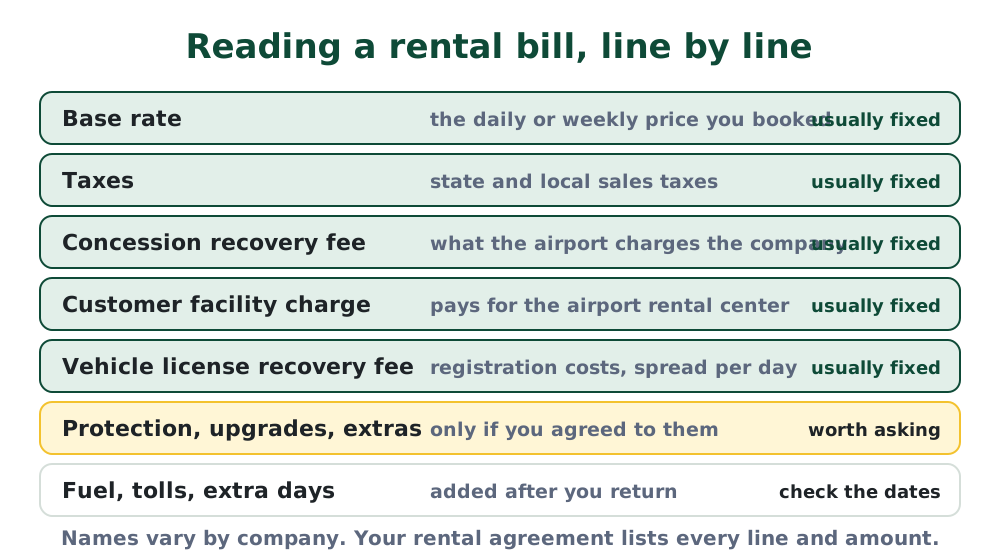
Once you see the bill as layers, it stops being a wall of jargon. The top layer is the price you booked. Under it sit the taxes and location fees that come with renting in that particular spot. Under those sit the optional extras. And the very last layer, the one that often arrives days or weeks later, is what happened while you had the car: fuel, tolls, extra time, and occasionally a ticket or a cleaning charge.
Here is the habit that saves people money: before you sign at the counter, ask to see the estimated total with every line on it, not just the daily rate. Read it the same way the diagram above does. If something sits in the yellow zone and you don't remember saying yes to it, that is the moment to ask, not three weeks later on your card statement.
Why does the same car cost more at the airport than across town?
Because the airport charges the rental company for the privilege of being there, and that cost is passed on to you. The concession recovery fee and the customer facility charge exist because the counter sits inside or next to the terminal. A neighborhood branch a few miles away usually doesn't pay those, so its bill doesn't carry them.
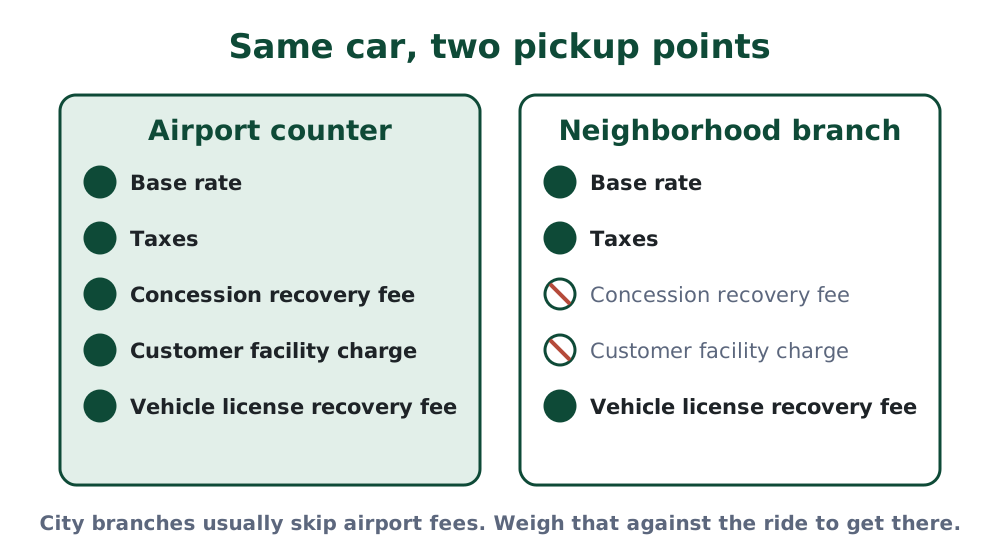
That doesn't make the city branch the automatic winner. You have to get there, and a rideshare from the terminal can eat a good part of the saving, especially for a one or two day rental. Neighborhood branches also keep shorter hours than airport counters, which matters if you land late or fly out early. The math tends to favor the city branch on longer rentals, when the airport fees are charged on a bigger base, and when the branch is an easy, cheap hop from where you're staying.
A quick test before you book
Price the same dates twice: once at the airport, once at the nearest neighborhood branch. Compare the totals with taxes and fees, then subtract what the ride to the branch will cost you each way. If the difference is still worth the effort, book the branch. If it's close, keep the airport and enjoy walking straight to the car.
Which charges show up only after you return the car?
This is the part of the bill that catches people off guard, because it often lands after the receipt you were handed at drop-off. The usual suspects are tolls, fuel, extra time, traffic or parking tickets, and cleaning. Each has its own clock and its own logic.
- Tolls travel through the toll authority to the rental company before they reach you, so they commonly post one to several weeks later, with a per-day fee on top. See toll fees, company by company.
- Fuel is usually settled at check-in, but a check-in done later by a staff member or a scanner can add a refueling charge after the fact. See charged for fuel after you filled up.
- Extra time appears when the check-in time is later than your return time, which is common after an after-hours drop-off. See late return charges.
- Tickets and camera fines can take months, and the rental company usually adds its own admin fee for passing your details on. See the ticket admin fee.
- Cleaning or smoking fees follow an inspection after you've gone. See cleaning and smoking fees.
The common thread is proof. A minute of photos at drop-off covers almost all of these: the dashboard with fuel and mileage, the four sides of the car, the interior, and the car parked in the return lane. Those pictures carry a time stamp, which quietly settles most arguments before they start.
What are the counter extras, and which ones do you actually need?
The counter is where a reasonable price can quietly double. Not through anything sneaky, necessarily, but because every extra sounds sensible when someone explains it kindly at the end of a long flight. The trick is to decide before you arrive, so the conversation is a quick yes or no.
- Damage waiver. It covers damage to the rental car itself. Before you take it, check whether your own car insurance extends to rentals and whether the card you're paying with includes rental car cover. Many travelers already have one of the two. If you have neither, the waiver can be well worth it.
- Liability cover. It protects you if you damage someone else's car or property. If you own a car and carry liability insurance, it often follows you into a rental within the US. Visitors from abroad usually don't have that, so it deserves a careful look.
- Personal accident and effects cover. Often overlaps with health and travel insurance you already carry.
- Roadside assistance upgrade. Basic help with mechanical problems is usually included. The paid add-on tends to cover things like lockouts, lost keys and running out of fuel.
- Toll pass. Worth it if you'll be on toll roads most days; poor value for one bridge on one day.
- Prepaid fuel. Only makes sense if you'll bring the car back nearly empty and don't mind leaving some fuel behind.
- Upgrade. Sometimes a genuine bargain, sometimes not. Ask for the new total, not the extra per day.
None of these are traps in themselves. The expensive mistake is buying cover you already have twice over, or declining cover you genuinely don't have. If you aren't sure where you stand, that's exactly the kind of thing to sort out on a call before the trip, not with a line forming behind you.
Why do per-day fees matter so much on a long rental?
A few dollars a day looks like nothing on a weekend. On a three week rental it becomes a line worth reading twice. Fees that are charged per rental day, such as the vehicle license recovery fee, some facility charges and most add-ons, grow in a straight line with the length of the trip. Percentage-based taxes and the concession recovery fee grow with the base price, so a bigger rental means a bigger fee too.
That's why long rentals reward a little planning. Picking up away from the airport, declining add-ons you already have cover for, and choosing the right car class from the start all compound over the weeks. If you're renting for a month or more, it's also worth reading our guide to long-term rentals, because the price structure on those programs can be quite different.
How do you check your final bill in five minutes?
Keep this routine for when the final receipt lands in your email. It takes about five minutes and catches the vast majority of mistakes.
- Dates and times. Do the pickup and return times match what actually happened? An extra day changes every per-day line on the bill.
- Car class. Is it the class you booked or agreed to? A higher class quietly lifts the base rate and every percentage fee.
- Extras. Is every add-on one you said yes to? Look for protection products, roadside upgrades, toll programs and prepaid fuel.
- Fuel line. If you refueled, there should be no refueling charge. Keep your fuel receipt ready.
- Location fees. If you picked up at a city branch, airport fees shouldn't be there.
- Later charges. Watch your card for a few weeks for tolls and tickets, and match each one to a day of your trip.
If a line looks wrong
Write to the rental company, quote your agreement number, name the line you're questioning and attach your proof. Keep it short and factual. If you'd like a second pair of eyes first, leave your number and an agent will go through the bill with you before you send anything.
Questions people ask
What is a concession recovery fee on a rental car?
It's the rental company passing on what it pays the airport or property owner for operating there. Avis describes it as a fee collected and remitted to the owner of the property where you rent.
What is a customer facility charge on a rental car?
A fee for building and improving the airport's rental car facilities, added to airport rentals.
What is a vehicle license recovery fee?
It recovers the cost of licensing and registering the car. Budget describes it as the company's share, prorated per rental day, of the costs to license the car.
Why is renting a car at the airport more expensive?
Airport rentals add fees such as the concession recovery fee and customer facility charge. An off-airport branch often doesn't charge them.
Related help
- Pay less: memberships, military and card cover
- Charged after you returned the car
- How to rent a car at a US airport
- Rental car toll fees, company by company
OneCall Rental is an independent service and is not affiliated with any rental company or travel site.
What happens when you call
Leave your name and number
That's all we need to start.
A real person calls you back
During our hours, 24/7, every day of the year. They stay with you until it's sorted.
We find you a way forward
And explain it in plain words.
You see everything in writing before you pay a cent
Nothing is charged until you say yes.
Pickup, drop-off, and everything in between. You've always got someone.
Planning a rental? Talk it through first
Tell us where and when. Your agent compares your options, spots the fees most people miss, and tells you the real total before you book.
Free call. We answer 24/7, every day of the year.