Need a car for a month or more?
The short answer
You have two choices. A long-term rental is a normal rental kept for weeks or months, often at a lower monthly rate. A subscription is one monthly payment with more bundled in, sometimes including insurance. Choose by how long you need the car and how you're insured.
Free call. We answer 24/7, every day of the year.
Or leave your number and we'll call you back.
Key takeaways
- Avis long-term: 15 to 330 days, no down payment, unlimited miles and maintenance included.
- Hertz Multi-Month: 63 days to 11 months. In Canada, contracts renew every 120 days.
- Subscribe with Enterprise: renews every 30 days and includes insurance, maintenance and roadside help, with up to four swaps a month.
- SIXT+: a 30-day minimum and a one-time $199 sign-up fee. Fuel is not included.
Rental or subscription: which suits me?
| Long-term rental | Subscription | |
|---|---|---|
| Insurance | Usually not included | Often included |
| Swapping cars | Through the branch | Built in |
| Commitment | Ends when you return the car | Renews each month until you cancel |
| Best for | Work trips, long visits, a known end date | Not sure how long you'll need it |
Figures from Avis, Hertz, Enterprise and SIXT's own websites, checked 24 October 2026.
How do I book one?
- Decide your rough start date and how many months you need.
- Check the company's long-term page, or ask the branch for its monthly rate.
- Ask what's included: miles, maintenance and damage cover.
- Check your insurance (see below) before you sign.
- Get the early-return rule in writing.
Will my credit card cover a long rental?
Often not. Many cards stop covering a rental after a set number of days in a row, commonly around 30. Call your card company and ask for the limit before you rely on it.
Watch out for
- Returning early. Some contracts re-price at the daily rate. Ask first.
- Auto-renewal. Subscriptions keep charging until you cancel.
- Fake pages. Unofficial pages use big brand names with their own phone numbers. Book only through the company's real website or branch.
No card to pay with? See Rent a car with no card. Car being repaired after a claim? See Rental through insurance.
Need a car for a month or more? Tell us how long and where, and our agent will help you choose between a rental and a subscription. Leave your number and we'll check it for your booking.
How do long-term rental programs compare?
The big companies each run their long-term rentals differently, and the minimum length decides which ones you can use. Here's how the programs on the companies' own websites line up.
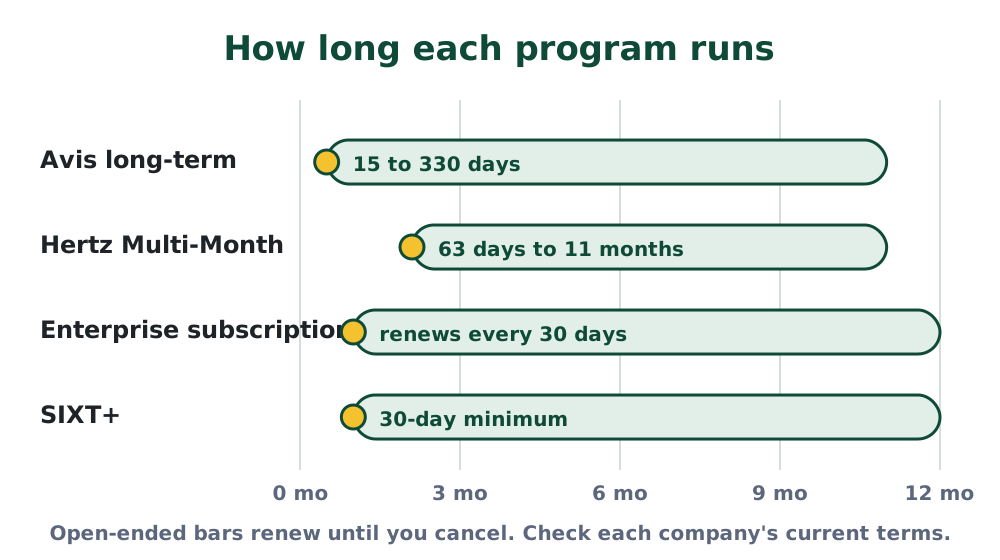
If you need a car for two to eight weeks, a normal rental with a weekly or monthly rate is often simplest. Past two months, a dedicated long-term program or a subscription is worth comparing, because some include maintenance, more miles or insurance in the monthly price.
Who rents a car for months, and what works for each?
| Situation | What usually works | Key thing to check |
|---|---|---|
| Relocating for a new job | A one to three month rental while you settle in and buy a car | Whether your employer's relocation package covers it |
| Your car is in the shop | A rental billed to your insurer | The daily limit and how many days your policy pays |
| Contract or travel nurse work | A long-term rental or subscription near the assignment | Insurance past 30 days, and early-return terms if the contract ends early |
| Students and interns | A long rental for a semester or summer | Young renter fees and allowed car classes |
| Long visits from abroad | A long-term rental with liability cover included | License rules for long stays and card deposits |
| Rideshare or delivery driving | Only a program built for it | Standard rental agreements usually ban commercial driving |
That last row matters. Most standard rental agreements don't allow using the car to drive for rideshare or delivery apps. Some companies have run special programs with rideshare platforms, with their own rules and insurance. If you plan to earn money with the car, ask before you sign, or your cover may not apply.

How do you set up a long rental, step by step?
- Decide the length and the end point. A rough end date helps you choose between a long rental and a subscription.
- Pick the location. A neighborhood branch near home or work is often cheaper than the airport and easier for swaps and maintenance.
- Get a written monthly quote that includes taxes, fees and what's covered: miles, maintenance, roadside help and insurance.
- Sort your insurance before pickup, with the limit in days confirmed in writing.
- Agree the billing card and cycle, and make sure the card has room for each charge and the deposit.
- Ask about tolls and parking permits if you'll commute or park in a city.
- Put the end date and any notice period in your calendar, so a subscription doesn't renew by surprise.
How are you billed on a long rental?
Usually in cycles, not all at once. Most long rentals charge your card at the start of each period, often every month or every few weeks, rather than one huge payment at the end. That's good for cash flow, but it means your card needs room for each charge plus the deposit hold, every time.
- Ask how often you'll be charged and on which card. If that card expires during the rental, update it before the next cycle.
- Ask about the deposit. Some companies hold a deposit for the whole rental. Others release and re-hold it each cycle.
- Ask whether the rate is locked. Some long rentals are re-priced at renewal, especially subscriptions.
What are the real monthly costs to budget for?
The monthly price is only part of it. Before you compare offers, put every line on one page.
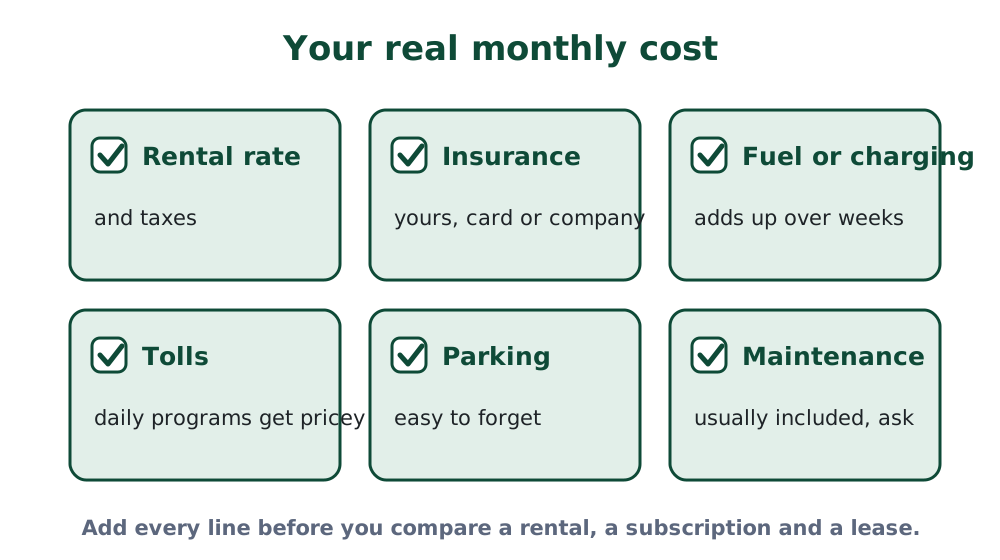
- Rate and taxes. Taxes and airport fees apply to long rentals too. Picking up away from the airport can cut them.
- Insurance. If it isn't included, check your own auto policy, a non-owner policy, or the rental company's cover. See below.
- Fuel and charging. On a long rental, fuel economy adds up. A smaller car or a hybrid can save more than a lower daily rate.
- Tolls. A rental toll program charged per day can become a large monthly bill. Ask whether you can use your own toll transponder. See toll fees by company.
- Parking. Easy to forget in cities.
- Maintenance. Most rentals include it, but you'll need to bring the car in when it's due.
What insurance works for a car you keep for months?
This is the question that catches people most. Short-term rules don't always stretch to long rentals.
- Your own auto policy. Many personal policies extend to a rental car, but some limit how long. Ask your insurer for the limit in days, and whether it covers liability and damage.
- Credit card cover. Card benefits usually stop after a set number of days in a row, commonly around 30, and some exclude certain vehicles. A month-long rental can fall outside the benefit without you knowing.
- A non-owner policy. If you don't own a car, a non-owner auto policy can give you liability cover for long rentals. Ask an insurance agent in your state.
- The rental company's cover. Simple, but expensive over months. On a subscription, insurance may already be included.
Whatever you choose, get the answer in writing before you sign. If you're on a long rental because your own car is being repaired, see rental through your insurance.
Can you swap cars during a long rental?
Usually, yes. On a long rental you may need to bring the car in for maintenance, a recall or a mileage limit, and the branch swaps you into another car. Subscriptions often build swaps in. Each swap is a fresh car handover, so treat it like a new pickup: take photos of the new car, check the fuel level, and make sure the old car is checked in without new damage on your record. See changing your car during a rental.
Long-term rental, subscription, lease or peer-to-peer: which fits?
| Option | Best for | Watch out for |
|---|---|---|
| Long-term rental | One to several months with a known end date | Insurance limits, tolls, early-return pricing |
| Subscription | Unsure how long, want insurance and swaps bundled | Sign-up fees, auto-renewal, mileage caps |
| Lease | Two to three years or more | Long commitment, early-exit costs, credit checks |
| Peer-to-peer car sharing | Specific cars or areas the big companies don't serve | Insurance differences, host rules, pickup logistics |
For students, interns, contract workers and people relocating, a long rental bridges the gap until you buy or lease. If you're visiting from abroad for months, check the license rules for long stays in your state, which can differ from a short visit. See renting from abroad.
Are miles limited on a long rental?
Sometimes. Many standard rentals from the major companies include unlimited miles, but long-term programs and subscriptions can set a monthly allowance, with a charge per mile above it. If you commute a long way or plan road trips, estimate your miles per month and compare it to the allowance before you choose. Some programs also ask you to swap the car after a certain mileage for maintenance.
Can you drive a long rental out of state?
Usually, within the US and often into Canada, but check. Some agreements limit where the car can go, and a few branches restrict travel for long rentals. If you'll be based in another state for months, tell the branch, because some companies prefer you to swap the car at a local branch rather than keep a car registered elsewhere for a long time. For Canada, confirm the border rules and carry the agreement. See crossing the border.
What should you check at every swap or maintenance visit?
- Photos of the new car, all round, before you drive off.
- The fuel or charge level on the agreement matches the car.
- The old car is checked in with no new damage noted against you, and you have a record of that.
- Your toll transponder or program moves to the new car if you use one.
- The monthly rate and end date stay the same on the new paperwork.
Swaps are where small mistakes creep into long rentals: a damage mark carried over from the old car, a fuel charge, or a changed rate. Two minutes of checking saves a dispute later. See damage claims.
How do car subscriptions work?
A subscription is one monthly payment for a car, with more bundled in than a normal rental. Using the companies' own terms, checked 24 October 2026:
- Subscribe with Enterprise renews every 30 days and includes insurance, maintenance and roadside help, with up to four car swaps a month.
- SIXT+ has a 30-day minimum and a one-time sign-up fee of $199. Fuel isn't included.
Subscriptions suit people who don't know how long they'll need a car, or who don't have their own auto insurance. They cost more per month than some long rentals, so compare the full monthly cost, including insurance you'd otherwise buy, rather than the headline price. Always check how to cancel and how much notice you need, because subscriptions keep charging until you stop them.
Do long rentals work differently in Canada?
Some do. Hertz, for example, says its Multi-Month contracts in Canada renew every 120 days. Taxes, insurance rules and winter tire requirements also differ by province. Quebec, for example, requires winter tires in the winter months, so rentals there come equipped for it. If you're renting long-term in Canada, or driving a US rental into Canada for weeks, ask the company about the renewal cycle, cross-border rules and winter equipment before you sign. See renting between Canada and the US.
What happens if you need to return the car early?
Ask before you sign, because this is where long rentals differ most. Some long-term programs let you return early and only charge for the time used, at the long-term rate. Others re-price the whole rental at a shorter, more expensive rate, so ending a planned three months after six weeks can cost more than you expect. Subscriptions usually end at the next renewal if you give the required notice. Get the early-return rule in writing, and if your plans are uncertain, a subscription or a month-by-month rental may be safer than a fixed long-term contract.
How do you end a long rental without surprises?
- Give notice if the contract asks for it, especially on subscriptions that renew automatically.
- Return it on the agreed date. Ending early can re-price the whole rental at a higher rate. Ending late can add days at a higher rate. Ask before either.
- Clean it out. After months in a car, belongings and heavy dirt are common. Cleaning fees apply for excess mess. See cleaning fees.
- Get a final closed receipt, and check every monthly charge against it.
Our tip from real calls
On long rentals, the most common surprise is a toll bill. A daily toll program charged across many weeks adds up fast. Ask on day one how tolls are billed, and whether your own transponder can be used instead.
Questions people ask
What is the longest you can rent a car for?
Avis long-term rentals run up to 330 days, and Hertz Multi-Month up to 11 months.
Is a car subscription cheaper than a long-term rental?
It depends. Subscriptions often include insurance, so compare the full monthly cost, not just the headline price.
Does my credit card cover a monthly rental?
Often not past a set number of days in a row, commonly around 30. Ask your card company.
Related help
- Pay less: memberships, military and card cover
- Rent a car with no card
- Extending a rental car
- Before you book
OneCall Rental is an independent service and is not affiliated with any rental company or travel site.
What happens when you call
Leave your name and number
That's all we need to start.
A real person calls you back
During our hours, 24/7, every day of the year. They stay with you until it's sorted.
We find you a way forward
And explain it in plain words.
You see everything in writing before you pay a cent
Nothing is charged until you say yes.
Pickup, drop-off, and everything in between. You've always got someone.
Planning a rental? Talk it through first
Tell us where and when. Your agent compares your options, spots the fees most people miss, and tells you the real total before you book.
Free call. We answer 24/7, every day of the year.