Damage claim weeks or months after you returned the rental car?
The short answer
Don't pay and don't ignore it. Ask in writing for the evidence: dated photos, the inspection report, the repair estimate and an itemized bill. Then check what cover you already have, and keep an eye on the clock, because card disputes have time limits.
Free call. We answer 24/7, every day of the year.
Or leave your number and we'll call you back.
Key takeaways
- Don't pay a rental car damage claim before you've seen the evidence.
- Ask for dated photos, the inspection report, the repair invoice and an itemized bill.
- Loss of use, administration and diminished value are separate charges, and each has to be justified.
- US card disputes generally have to be made within 60 days of the statement showing the charge.
If this is you right now
You returned the car, nobody mentioned a scratch, and a week or two later an email arrives from a damage or claims team. It names a figure in the hundreds or thousands, attaches a few photos you've never seen, and offers a discount if you pay quickly.
What should I do first?
- Don't pay straight away. A quick-payment discount is designed to close the claim before you look at it.
- Reply in writing and keep everything in one email thread.
- Find your own evidence: pickup and return photos or video, the return receipt, the time you dropped the car off, and any check-in slip.
- Note your dates: when you rented, when you returned, and when the claim and any card charge appeared.
What should I ask the rental company for?
- Dated photos of the damage, ideally taken at check-in.
- The inspection or check-in report, and who did it.
- The repair estimate or final repair invoice.
- An itemized bill. Damage claims are often several charges stacked together, such as repairs, administration and “loss of use”, the days the car couldn't be rented out.
- Any record showing the car's condition before your rental, if the damage could already have been there.
Can they charge my card for damage without asking?
Many rental agreements let the company charge the card on file for damage, which is why claims sometimes appear as a charge rather than a letter. Whether a particular charge stands up depends on your agreement, the evidence and the cover you had. If a charge has already gone through, don't dispute it with your bank blindly: a dispute sent without evidence often fails, and it's hard to try again.
Not sure whether your card, travel policy or the counter waiver covers this? Leave your number and we'll check it for your booking.
How long do I have to dispute a charge?
In the US, card disputes generally have to be made in writing within 60 days of the statement that first showed the charge. Card issuers can set their own windows, and some are shorter, so check yours as soon as the charge appears.
How do I dispute a rental car damage claim, step by step?
- Write back within a few days and say you don't accept the claim until you've seen the evidence.
- Ask for the documents listed above, in one email.
- Compare their photos with yours: same panel, same mark, dated before or after your rental?
- Check your cover: the waiver you bought at the counter, your credit card's rental cover, your travel or car insurance.
- Answer each charge separately: repair, loss of use, administration, diminished value. Each has to be justified on its own.
- Keep it in writing and keep copies. If a charge has already reached your card, note the statement date for the dispute window.
A reply you can send
Subject: Damage claim on rental agreement [your agreement number]
Hello,
I've received your damage claim for the vehicle I rented from [pickup date] to [return date]. I don't accept the claim at this stage. Please send me:
- dated photos of the damage, including the check-in photos;
- the vehicle inspection or check-in report, and who completed it;
- the repair estimate or final repair invoice;
- an itemized bill, including any loss of use or administration charges and how they were calculated;
- the vehicle's condition record from before my rental.
Please don't charge my card while this is being reviewed. I'll reply once I've seen the evidence.
Thank you,
[Your name]
Fill in the brackets and keep the whole conversation in one email thread.
They found the damage after I'd left, with no proof. Is that allowed?
Companies can inspect a car after you return it, but the claim still has to be backed by evidence that the damage happened during your rental. If the car was checked in hours later, or after an after-hours drop-off, ask for the check-in time, who did it, and the photos from both pickup and return. Enterprise and Avis say that with an after-hours return you stay responsible until the car is checked in, which is why your own drop-off photos matter so much. See after-hours returns.
Who is the Damage Recovery Unit?
It's the team some rental companies, including Enterprise, use to handle damage claims and gather information after an accident or damage report. A letter or call from them means a claim has been opened. Reply in writing and ask for the evidence before you agree to anything.
Windshield chips and tires: am I responsible?
Often, yes, under the rental agreement, unless the damage waiver you bought covers it. Chips and tire damage are some of the most common claims because they're easy to miss at pickup. Check the windshield and tires when you collect the car and photograph anything you see, and ask for the repair invoice if you're charged.
What if I didn't take photos when I returned the car?
You can still question the claim. The company has to show the damage happened during your rental, so its own check-out and check-in records matter most. Look for anything that fixes the car's condition and time: your return receipt, the time you dropped it off, a key-drop receipt, fuel or toll receipts from the last day, or photos you took for any other reason. If the car was returned after hours and inspected later, say so, because nobody checked it with you.
Does my credit card cover rental car damage?
Many credit cards include rental car damage cover, but only if you paid for the rental with that card and usually only if you declined the counter's damage waiver. Some cards pay first, others only after your own insurance, and most have claim deadlines and a list of documents they need. Find your card's benefits guide, or call the number on the back of your card, before you pay anything yourself.
Not sure whether your card covers it? Leave your number and we'll check it for your booking.
What should you do at pickup and drop-off so a claim never sticks?
The strongest defense against a damage claim is built before it ever arrives: a careful walk-around at pickup and again at drop-off. It feels a little fussy in a busy parking lot. It is also the single habit that turns a stressful letter into a two-line reply.
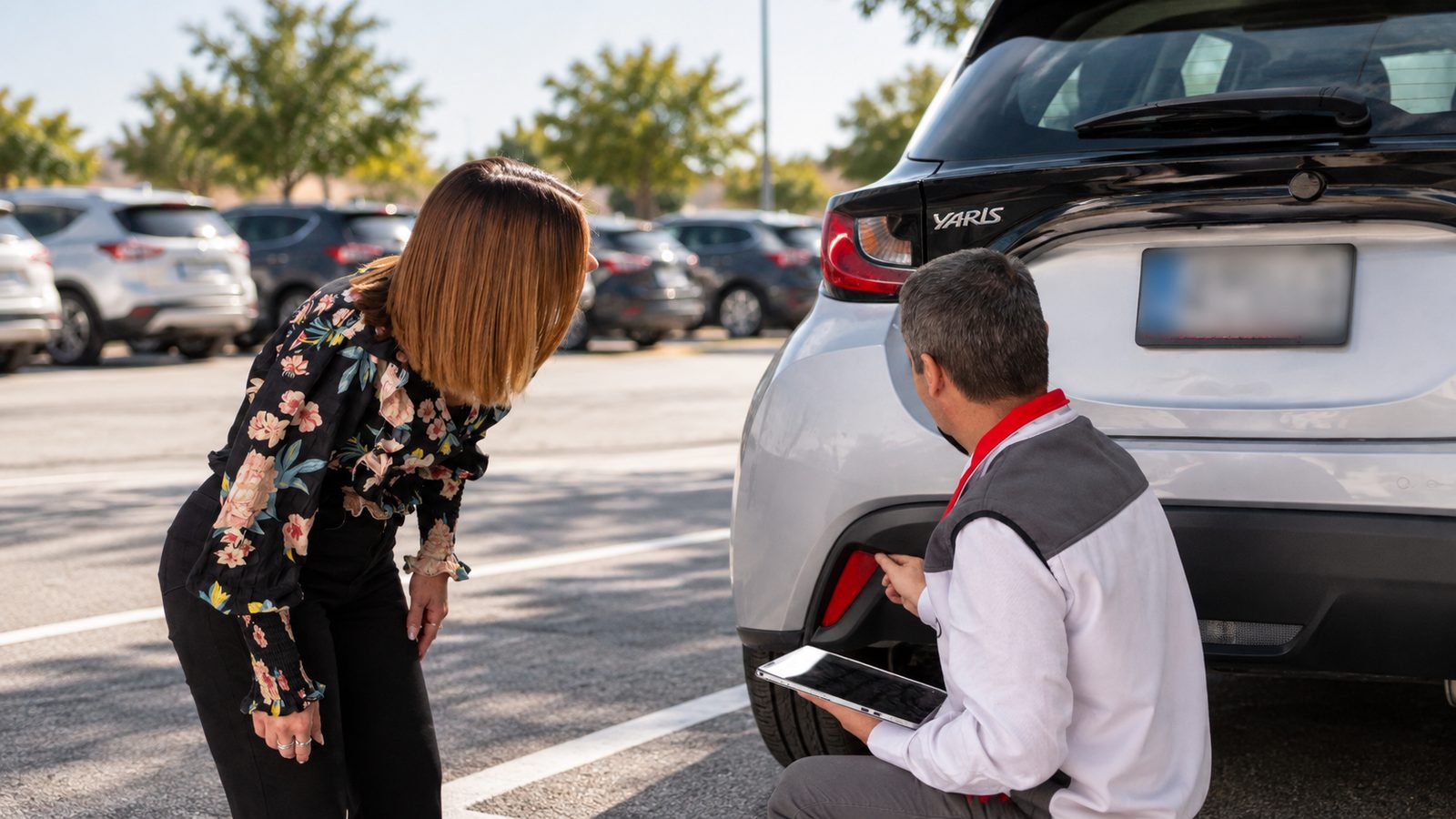
- Film a slow lap of the car at pickup, then photograph anything you spot up close: scratches, dents, chips in the windshield, scuffed wheels.
- Show it to someone before you drive off if there's an agent nearby, and ask them to note it on the agreement.
- Don't forget the roof, bumpers and lower doors, which are easy to miss and common places for claims.
- Repeat the lap at drop-off, in the return lane, with the time stamp on your phone.
Those two short videos give you something solid to compare against any photos the company sends later. Same panel, same mark, before or after your rental: that question answers most claims on its own.
What does a damage claim usually include?
A claim letter often shows a single total, but that figure is frequently several charges stacked together. Breaking it apart is the first step toward answering it properly.
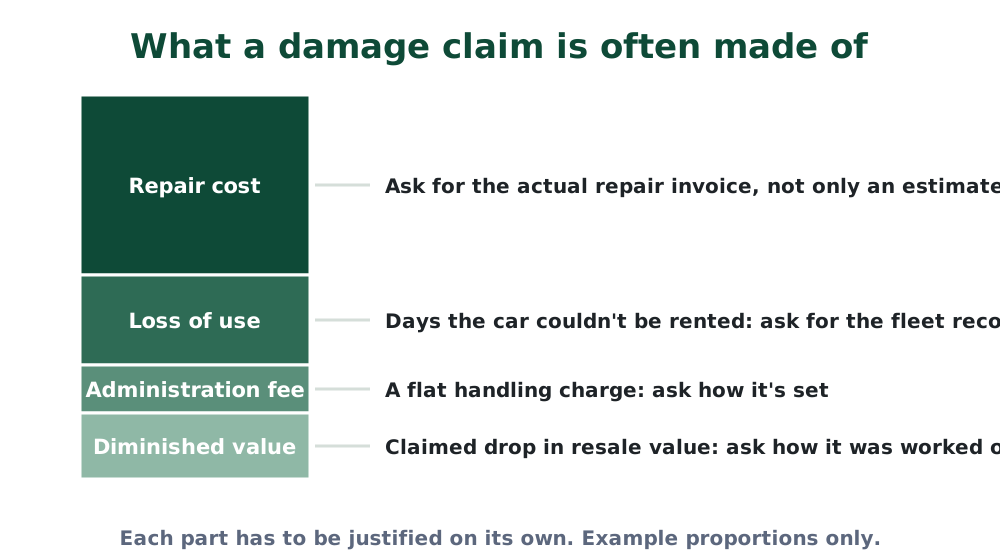
The repair cost should be backed by an actual repair invoice, or at least a detailed estimate. Loss of use is the rental income the company says it lost while the car was off the road, so it's reasonable to ask how many days were counted and whether the company really had no other car to rent in its place. An administration fee is a handling charge; ask how it's set. Diminished value is a claimed drop in the car's resale value after the repair, and it deserves a clear explanation of how it was worked out.
Step by step: how do you handle a claim calmly?
Claims are designed to feel urgent. A short, steady routine keeps you in control.
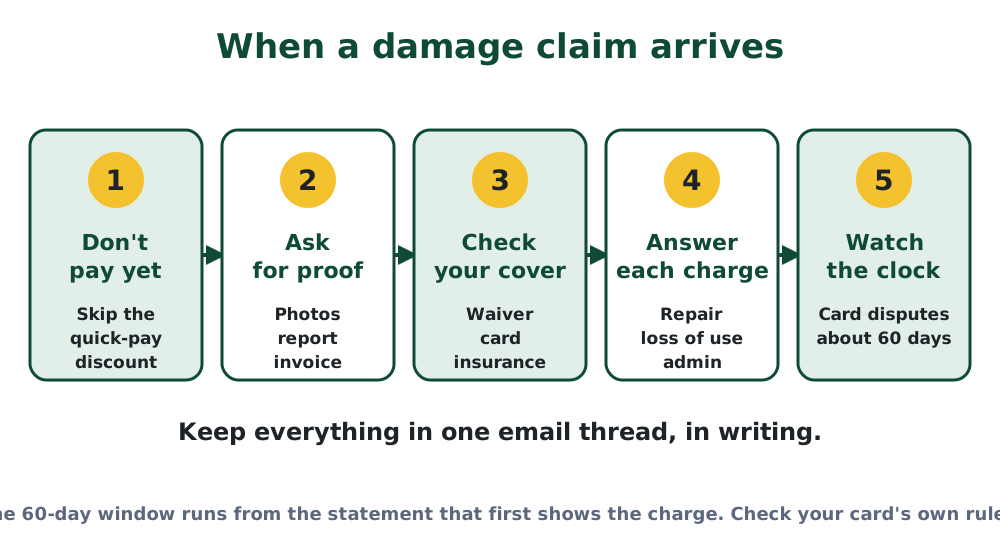
Most of the work is in steps two and three. Asking for proof is covered above, with a reply you can send. Checking your cover means looking at the waiver you bought at the counter, your own car insurance, and the card you paid with, in that order. Card cover often has its own claim process and its own deadline, so if you're relying on it, contact the card issuer early rather than waiting for the rental company to finish.
When is it worth getting help?
Plenty of claims can be handled with a calm email and your own photos. Get help when the amount is large, when the company won't share its evidence, when a charge has already hit your card, or when several types of cover overlap and you're not sure which to use first. A wrong first move, like disputing with your bank before you've asked the rental company for its evidence, can make the next step harder.
Not sure where to start?
Leave your number. An agent will read the claim with you, help you work out what to ask for and which cover applies, and keep an eye on the dates. You stay in control and send everything yourself.
Questions people ask
Can a rental company charge me for damage after I've returned the car?
Yes, most rental agreements allow it, which is why the evidence matters. Ask for dated photos, the inspection report, the repair estimate and an itemized bill before you pay.
What is loss of use on a rental car damage claim?
It's a charge for the days the car couldn't be rented while it was being repaired. It is usually listed separately from the repair, and it's one of the items worth asking the company to justify.
Should I pay a rental car damage claim quickly to get the discount?
Not before you've seen the evidence and checked your cover. A quick-payment discount can mean paying for damage you didn't cause.
How do I dispute a rental car damage claim?
Reply in writing, ask for the dated photos, inspection report, repair invoice and an itemized bill, compare them with your own evidence, check your cover, and question each charge separately. Don't pay until you've seen the evidence.
What if I didn't take photos when I returned the rental car?
You can still dispute it. The company has to show the damage happened during your rental. Use your return receipt, drop-off time and any other record of the car's condition, and point out if it was inspected after you left.
Does my credit card cover a rental car damage claim?
Often, if you paid for the rental with that card and declined the counter's damage waiver. Check your card's benefits guide for the conditions and claim deadline before paying anything yourself.
Can a rental company bill me for damage months after I returned the car?
It can try, which is why the evidence matters. Ask for dated photos from pickup and return, the check-in record and the repair invoice, and point out how long after your return the damage was found.
Can a rental company send a damage claim to collections?
Unpaid claims can be passed to a collection agency, so don't ignore the letters. Keep replying in writing, ask for the evidence, and keep copies of everything.
Who can help me fight a rental car damage claim?
Leave your number and one OneCall agent goes through the claim with you, helps you gather your evidence and get the timing right. You stay in control and send it yourself.
Related help
- Charged after you returned the car
- Cleaning or smoking fee after return
- Rental car toll fees, company by company
OneCall Rental is an independent service and is not affiliated with any rental company or travel site.
What happens when you call
Leave your name and number
That's all we need to start.
A real person calls you back
During our hours, 24/7, every day of the year. They stay with you until it's sorted.
We find you a way forward
And explain it in plain words.
You see everything in writing before you pay a cent
Nothing is charged until you say yes.
Pickup, drop-off, and everything in between. You've always got someone.
Charged after you returned the car?
Your agent helps you understand the charge, gather your evidence and challenge it the right way. You stay in control.
Free call. We answer 24/7, every day of the year.